
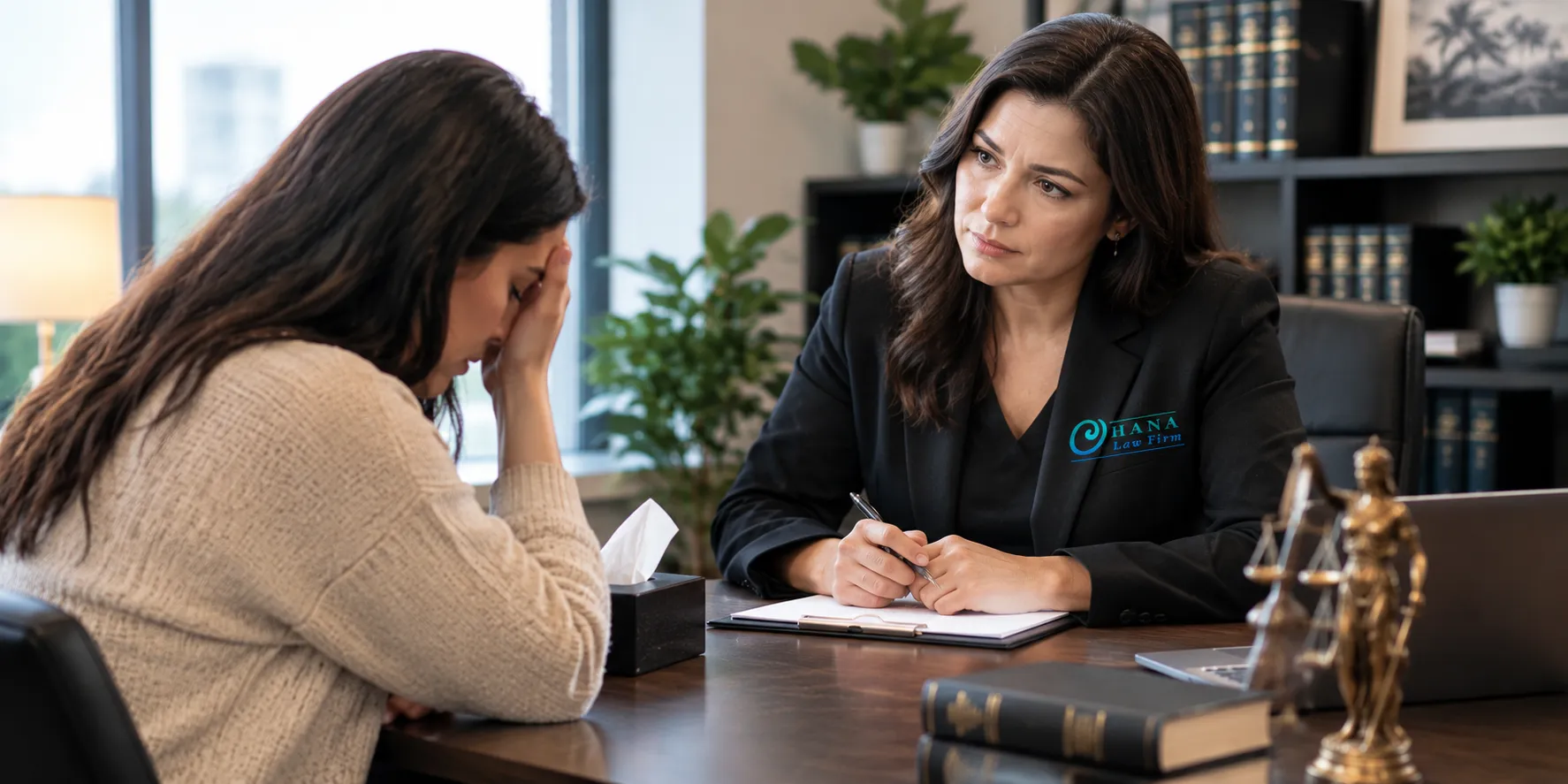
A mother in the Puna district came to Ohana Law Firm after years of documented abuse from her husband. William Dean helped her obtain a protective order under Hawaii Revised Statutes Chapter 586 and later secured full custody protections for her children under HRS Section 571-46.
Domestic violence divorce Hawaii cases involve more than an ordinary split. Hawaii Family Court treats safety, custody, and property differently once abuse enters a case, and the timeline for protection moves much faster than the timeline for divorce.
This article is for educational purposes only and does not constitute legal advice. For advice specific to your situation, contact a licensed Hawaii attorney before taking any legal action.
| Domestic violence divorce in Hawaii lets victims seek an immediate protective order under HRS Chapter 586 while filing for divorce under HRS Chapter 580. A judge can grant a temporary restraining order the same day, with a full hearing within 15 days. Abuse also creates a rebuttable presumption against custody for the abusive parent under HRS 571-46. |
What Is Domestic Violence in a Hawaii Divorce?
Domestic violence in a Hawaii divorce means physical abuse, threats, harassment, or extreme psychological control by a spouse or household member. Hawaii Revised Statutes Chapter 586 defines domestic abuse broadly, covering physical harm, the threat of physical harm, and extreme emotional distress caused to a family or household member.
You do not need to file for divorce first. Under HRS Section 586-4, a family court judge in the Hawaii Third Circuit Court can grant a temporary restraining order the same day you petition, even before any divorce papers are filed.
Many Big Island clients start with the protective order and file for divorce afterward, once they and their children are safe. The two processes run on separate tracks in Hawaii Family Court, though the same judge often handles both.
Domestic abuse under HRS Chapter 586 is not limited to spouses. The law also covers former spouses, people who share a child, and other household or family members, so the protections apply even before a divorce is legally possible.
Hawaii also recognizes psychological abuse and coercive control as forms of domestic abuse under HRS Chapter 586, not just physical violence. Extreme emotional distress caused through threats, isolation, or intimidation can support a protective order petition.
How Hawaii Protective Orders Work: Key Facts
A Hawaii protective order moves through two clear stages. First, the court issues an ex parte temporary restraining order (TRO) without notice to the abuser, based only on the petitioner’s sworn statement. Second, the court holds a hearing to decide whether the order continues.
The TRO itself can last up to 180 days under HRS Section 586-5, or until a hearing takes place, whichever comes first. Hawaii law requires that hearing within 15 days of the TRO being granted.
At the show cause hearing, a judge can extend the order into a longer protective order under HRS Section 586-5.5, covering custody, visitation, and firearm surrender under HRS Section 134-7. There is no court filing fee for a Hawaii protective order petition.
Petitioners who allege domestic abuse have the right to attend the show cause hearing remotely under Hawaii law, which recognizes that travel and childcare can be significant burdens across Big Island districts like Puna and Kona.
Hawaii Domestic Abuse Protective Order Timeline
| Stage | What Happens | Typical Timeframe |
|---|---|---|
| Petition filed | Family Court judge reviews the petition, same day | Same day |
| Ex parte TRO | Order granted without notice to the abuser, if warranted | Immediate |
| Service on abuser | Police or process server delivers the TRO | Days after filing |
| Show cause hearing | Judge hears evidence and decides on a longer order | Within 15 days |
| Extended protective order | Can include custody, visitation, firearm surrender | Set by the judge |
| A protective order and a divorce filing are two separate actions in Hawaii. You can request a TRO under HRS Chapter 586 right away and address the divorce itself, including property and support, on a separate timeline afterward. |
How Domestic Violence Affects Custody in a Hawaii Divorce
Domestic violence creates a rebuttable presumption against the abusive parent in Hawaii custody decisions. Under HRS Section 571-46(a)(9), once a judge finds a parent committed family violence, the court presumes that joint custody or sole custody with that parent is not in the child’s best interest.
The abusive parent can still present evidence to try to overcome that presumption, so documentation matters. Hawaii Family Court must also weigh the safety and well-being of the victimized parent as part of any custody decision.
Hawaii law also protects victims who relocate to escape abuse. A judge cannot hold your relocation or absence from the home against you when deciding custody, visitation, or the eventual divorce settlement under HRS Chapter 580.
If a child was conceived through sexual assault and the abuser was criminally convicted, HRS Section 571-46 bars that parent from custody or visitation in most circumstances, with narrow exceptions the court reviews carefully.
A judge can still grant an abusive parent supervised visitation if the arrangement protects both the child’s physical safety and psychological well-being and the safety of the parent who was the victim of the abuse. Courts on the Big Island weigh these factors case by case.
| If your child was present during incidents of abuse, document dates, injuries, and any police reports as soon as possible. This evidence is often central to custody decisions under HRS Section 571-46. Consult a licensed Hawaii attorney before taking any legal action based on this information. |
Steps to Take in Hawaii When Facing Domestic Violence and Divorce
Every case is different, but most Big Island clients follow a similar sequence when abuse and divorce overlap. Safety comes first, followed by documentation, followed by the legal filings themselves. Rushing the paperwork before you are safe can put you and your children at greater risk.
1. Get to safety first. Call 911 if you are in immediate danger, or contact the Domestic Violence Action Center helpline for guidance and shelter resources.
2. Petition the Hawaii Third Circuit Court in Hilo for a temporary restraining order under HRS Chapter 586, with or without an attorney.
3. Gather evidence, including photos, text messages, medical records, and any police reports documenting the abuse for the show cause hearing.
4. File for divorce under HRS Chapter 580 once you are safe, addressing custody, property division, and support separately from the protective order.
5. Contact a licensed Hawaii attorney before your show cause hearing so the custody and safety issues are presented correctly to the court.
When You Need a Hawaii Attorney for Domestic Violence and Divorce
You need a Hawaii attorney the moment safety, children, or property overlap with an abuse allegation. Representing yourself at a show cause hearing while also negotiating custody and property division is difficult even for experienced litigants.
William Dean, Esq. holds a JD from the William S. Richardson School of Law and an LLM in International Law from George Washington University, and has helped Big Island parents secure full custody in cases involving documented family violence.
The outcome of any legal matter depends on the specific facts and applicable law. Past results do not guarantee future outcomes, but an attorney can make sure your protective order, custody request, and divorce filing work together instead of against each other.
Ohana Law Firm has also secured a full marital estate award and a $5 million arbitration result in complex Hawaii cases, experience that carries over when a domestic violence divorce involves shared property, a business, or retirement accounts.
Ohana Law Firm Serves All Big Island Communities
Ohana Law Firm represents domestic violence and divorce clients across Hawaii Island, from Hilo and Puna to Kailua-Kona and the Kohala Coast. We understand that Big Island geography can make reaching court or a shelter harder than on other islands.
Our office at 106 Kamehameha Ave, Suite B, Hilo, is close to the Hawaii Third Circuit Court at Hale Kaulike, 777 Kilauea Avenue. Ohana means family, and we treat every Big Island client like family during one of the hardest chapters of their life.
Whether you need help filing a protective order this week or planning a custody strategy for the months ahead, William Dean, Esq. is available around the clock for Big Island families facing domestic violence and divorce together.
Conclusion
Domestic violence divorce Hawaii cases require fast action on safety and careful legal strategy on custody and property. HRS Chapter 586 gives you a path to an immediate protective order, and HRS Section 571-46 protects your children once abuse is documented in Family Court. Acting early on both fronts, protection and divorce, gives Big Island families the strongest position.
This article is for educational purposes only and does not constitute legal advice. The outcome of any legal matter depends on the specific facts of your case. If you have questions about domestic violence and divorce on the Big Island, contact Ohana Law Firm for a free consultation.
| Ohana Law Firm serves Big Island residents 24/7. Call 808-430-0704 — your call goes straight to an attorney. Free consultation. Mahalo for reading. |
Frequently Asked Questions
What Hawaii law governs domestic violence in a divorce?
Hawaii Revised Statutes Chapter 586 governs domestic abuse protective orders, while HRS Chapter 580 governs the divorce itself. Custody decisions involving abuse fall under HRS Section 571-46, which creates a rebuttable presumption against granting custody to a parent found to have committed family violence.
How much does a domestic violence divorce cost in Hawaii?
Filing a protective order petition under HRS Chapter 586 has no filing fee in Hawaii Family Court. Attorney fees for the related divorce and custody case typically run $350 to $500 per hour on the Big Island. Ohana Law Firm offers a free consultation to review your specific situation.
How long does a Hawaii protective order take?
A judge can grant a temporary restraining order the same day you petition under HRS Section 586-4. The TRO lasts up to 180 days, and Hawaii Family Court must hold a show cause hearing within 15 days to decide whether to extend it into a longer protective order.
Does Ohana Law Firm handle domestic violence divorce cases on the Big Island?
Yes. Ohana Law Firm represents clients across Hilo, Kailua-Kona, and Puna in domestic violence divorce cases before the Hawaii Third Circuit Court. William Dean, Esq. has secured custody protections for both mothers and fathers in cases involving documented family violence.
When should I contact a Hawaii attorney about domestic violence and divorce?
Contact a Hawaii attorney as soon as safety allows, especially before your show cause hearing. Consult a licensed Hawaii attorney before taking any legal action, since custody, property, and protective order strategy often need to be coordinated together for the best outcome.
