
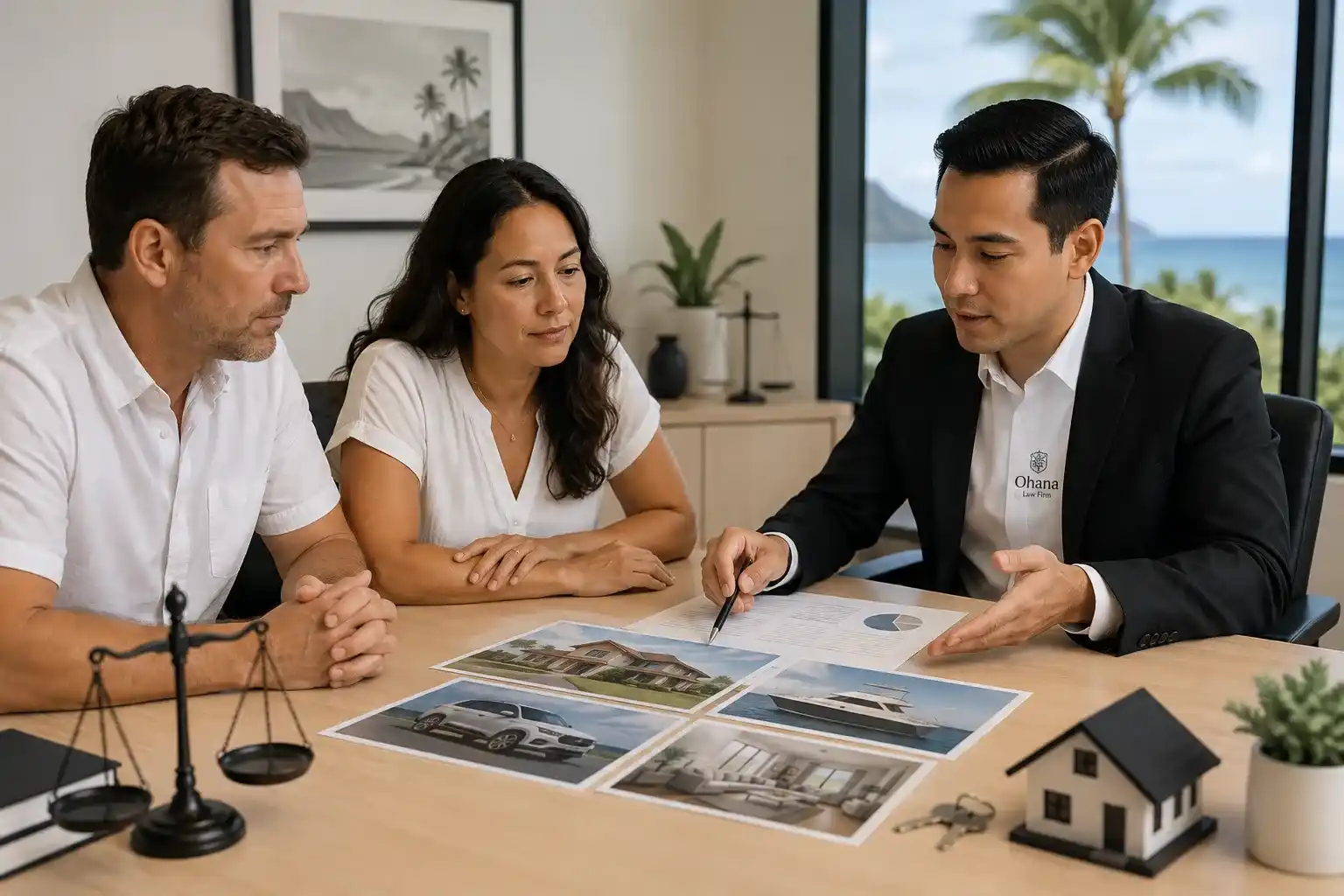
A couple in Kailua-Kona built a life together over fifteen years, including a jointly titled home and a small vacation rental near the Kohala Coast. When they decided to divorce, they assumed the family court would simply split everything down the middle, and they worried about losing the home their children grew up in.
Attorney William Dean explained that Hawaii property division law does not use a strict fifty-fifty formula. Under Hawaii Revised Statutes Chapter 580, specifically Section 580-47, the court weighs a range of factors to reach a just and equitable division of the marital estate. Learn more on our /property-division-hawaii/ service page.
This article is for educational purposes only and does not constitute legal advice. For advice specific to your situation, contact a licensed Hawaii attorney before taking any legal action.
| Hawaii is an equitable distribution state, not a community property state. Under Hawaii Revised Statutes Section 580-47, the Third Circuit Family Court divides marital property in a manner that is just and equitable, not automatically fifty-fifty. Judges weigh each spouse’s economic condition, contributions, and the burdens of raising children when dividing Big Island real estate, savings, and other marital assets. |
What Is Property Division in a Hawaii Divorce?
Property division answers one question. How will a divorcing couple’s home, savings, vehicles, retirement accounts, and debts be divided between them under Hawaii law. Hawaii Revised Statutes Chapter 580 governs this process for every divorce filed in the state, whether the case is contested or resolved by agreement.
Hawaii is one of forty-one states that uses equitable distribution rather than community property. That means the Third Circuit Family Court in Hilo does not automatically award each spouse half of everything the couple owns. Instead, the judge looks at the full financial picture of the marriage, including how long the couple was married and what each spouse contributed.
For Big Island couples, this often includes real estate on Hawaii Island, small business interests tied to tourism, agriculture, or hospitality, and retirement accounts built over years of work. Each asset gets evaluated individually, valued as of a specific date, and then folded into the overall division before the court reaches a final order.
This is different from many mainland states, and it means two Hawaii divorces with similar assets can end with different outcomes depending on each spouse’s individual circumstances and the factors a judge weighs under HRS 580-47.
How Hawaii’s Equitable Distribution Law Works Under HRS 580-47
Section 580-47 directs the family court to make a division that is just and equitable after weighing several statutory factors. These include the burdens placed on either spouse for raising the children of the marriage, the position each spouse will be in after the divorce, the relative abilities of each spouse to earn income, and the respective merits of the parties.
Hawaii courts often start from a working presumption of roughly equal division of what practitioners sometimes call marital partnership property, then adjust based on the statutory factors above. A spouse who gave up career opportunities or relocated to the Big Island to raise children, for example, may receive a larger share of the marital estate to offset that sacrifice.
Marital misconduct such as an affair is generally not a factor Hawaii courts weigh when dividing property, since Hawaii treats divorce as a no-fault process for most purposes. Financial misconduct is treated differently. If one spouse hides assets, spends marital funds on an affair, or otherwise dissipates the marital estate, the court can charge that spending against the responsible spouse when dividing what remains.
Because the statute gives judges broad discretion, the specific facts of a case, from income differences to who managed which accounts, can meaningfully shift the final outcome for Big Island families.
HRS 580-47 Factors Hawaii Courts Weigh
| Factor | What It Means |
| Burdens for the children | Which spouse carries primary day-to-day responsibility for the children |
| Post-divorce position | The financial and housing situation each spouse will be left in |
| Relative abilities | Each spouse’s ability to earn income and support themselves |
| Respective merits | The overall fairness of each spouse’s conduct and contributions |
| All other circumstances | Any additional facts relevant to a just and equitable result |
| Key Insight: Hawaii courts start from a presumption of roughly equal division, then adjust for these factors. This is not an automatic 50/50 split. | |
Marital Property Versus Separate Property in Hawaii
Marital property generally includes assets and debts acquired during the marriage, regardless of whose name appears on the title or account. This can include a home purchased jointly, retirement contributions made while married, and vehicles bought during the marriage, even if only one spouse’s name is on the paperwork.
Separate property typically includes assets owned before the marriage or received individually as a gift or inheritance during the marriage. A property inherited from a family member on the Big Island, for instance, often starts out as separate property belonging only to the spouse who inherited it.
Hawaii courts can, in some circumstances, reach into separate property when fairness requires it, which makes Hawaii’s approach different from many mainland states that strictly protect separate assets. A house purchased before marriage but improved with marital funds, or a business grown substantially during the marriage, can become a mixed asset requiring careful financial tracing to sort out.
Retirement accounts raise similar tracing questions. Contributions made before the marriage are usually separate, while contributions made during the marriage are usually marital, which means a single 401k or pension can require splitting into separate and marital portions.
This is one reason Big Island couples with inherited land, family businesses, or premarital homes benefit from an attorney who understands both the legal and financial sides of tracing these assets.
Marital Property vs. Separate Property: Quick Comparison
| Category | Typically Marital? | Example |
| Home purchased during marriage | Yes | Family home in Hilo bought after the wedding |
| Inheritance received individually | No (usually separate) | Land inherited from a parent |
| Retirement contributions during marriage | Yes | 401(k) growth while married |
| Property owned before marriage | No (usually separate) | Condo owned before the wedding |
| Business grown during marriage | Often mixed | Tourism business expanded after marriage |
How Big Island Real Estate Gets Divided in a Hawaii Divorce
Real estate is often the single largest asset in a Big Island divorce. A family home in Hilo, a vacation rental in Puna, or agricultural land in Hamakua all require a current professional appraisal before the court can divide their value fairly between the spouses.
One spouse often wants to keep the family home, particularly when children are involved and changing schools or neighborhoods would be disruptive. William Dean’s background in finance, including his Master of Science in Finance from Boston College, helps clients understand whether a buyout of the other spouse’s share, a sale with the proceeds split, or a delayed sale after the children are grown makes the most financial sense for their situation.
Jointly owned Big Island property can complicate matters further when one spouse wants to sell and the other does not.
Financing a buyout can also be harder for property in certain lava zone designations, which affects both insurability and a lender’s willingness to approve a new mortgage. In some cases, disagreement over jointly owned property can lead to a separate court process to force a sale if the couple cannot reach an agreement on their own.
| Legal Warning: Property in Lava Zones 1 and 2 can be harder to insure and finance, which may limit a spouse’s ability to buy out the other’s share of the family home. |
Steps to Take When Dividing Property in a Hawaii Divorce
Start by gathering financial records for every asset and debt from the marriage, including deeds, mortgage statements, retirement account statements, business records, and recent tax returns. Full financial disclosure is required in Hawaii Family Court, and missing or incomplete asset information can delay a case significantly or lead to accusations of hiding assets.
Next, get a professional appraisal for any Big Island real estate, retirement account, or business interest before agreeing to a division. Property values can shift quickly on the Big Island depending on location, lava zone designation, and market conditions, so relying on an outdated estimate can leave real money on the table for either spouse.
While the case is pending, the court can issue temporary orders addressing who stays in the family home, who pays which bills, and how jointly held accounts are used, so neither spouse is left without resources during the process.
Finally, discuss whether mediation or a negotiated settlement makes sense before heading to a contested hearing in front of a Third Circuit Family Court judge. Many Big Island couples reach a full agreement without a trial, which generally saves both time and legal expense compared to litigating every asset.
When You Need a Hawaii Attorney for Property Division
Property division becomes far more complicated when a business, significant real estate, retirement accounts, or premarital assets are involved. Attorney William Dean has helped Big Island clients reach favorable divisions of the marital estate, using his combined legal and financial training to evaluate complex assets that other attorneys may overlook or undervalue.
Business ownership adds another layer of complexity, since a Big Island tourism or agriculture business often needs its own professional valuation before it can be divided or offset against other assets. William Dean’s MS Finance degree from Boston College is particularly useful in these situations, where a purely legal background may miss important financial nuances.
The outcome of any legal matter depends on the specific facts and applicable law. Past results do not guarantee future outcomes, but experienced representation helps ensure nothing important gets missed during negotiations, financial disclosure, or at trial before the family court.
Ohana Law Firm Serves All Big Island Communities
Ohana means family, and Ohana Law Firm treats every Big Island client like family. Whether you live in Hilo, Kailua-Kona, Puna, or the Kohala Coast, William Dean is available 24/7 to talk through your property division questions and help you understand what a fair outcome might look like for your family.
If you have questions about property division on the Big Island, contact Ohana Law Firm for a free consultation. Mahalo for reading, and we look forward to helping your family move forward with confidence.
Conclusion
Hawaii’s equitable distribution law under HRS 580-47 gives Big Island families a fair, fact-specific process rather than a rigid formula. Understanding how marital and separate property, real estate, and retirement accounts get evaluated helps you plan ahead with confidence.
If you have questions about property division on the Big Island, contact Ohana Law Firm for a free consultation. This article is for educational purposes only and does not constitute legal advice; for advice specific to your situation, contact a licensed Hawaii attorney before taking any legal action.
| Ohana Law Firm serves Big Island residents 24/7. Call 808-430-0704 — your call goes straight to an attorney. Free consultation. Mahalo nui loa. |
Frequently Asked Questions
What Hawaii law governs property division in a divorce?
Hawaii property division in divorce is governed by Hawaii Revised Statutes Chapter 580, specifically Section 580-47. This statute directs family courts to divide marital property in a manner that is just and equitable, considering each spouse’s economic condition, contributions, and circumstances rather than applying an automatic fifty-fifty split.
How much does dividing property cost in a Hawaii divorce?
Legal fees for property division vary based on complexity and whether the case is contested. Straightforward cases with full agreement typically cost less than disputes involving business valuations or Big Island real estate appraisals. Ohana Law Firm offers a free consultation so you can understand your likely costs before committing to representation.
How long does property division take in a Hawaii divorce?
Property division timelines depend on whether spouses agree on asset values and division. Uncontested cases can resolve in a few months once financial disclosures are complete. Contested cases involving Big Island real estate appraisals, business valuations, or retirement account calculations can take considerably longer through the Third Circuit Family Court.
Does Ohana Law Firm handle property division cases on the Big Island?
Yes, Ohana Law Firm represents clients on property division matters throughout the Big Island, including Hilo, Kailua-Kona, and Puna. William Dean regularly handles cases involving Big Island real estate, jointly owned vacation rentals, and family businesses, bringing both legal and financial background to complex marital estate questions.
When should I contact a Hawaii attorney about property division?
You should contact a Hawaii attorney as soon as you know divorce is likely, especially if real estate, a business, or retirement accounts are involved. The outcome of property division depends on the specific facts of your case, so early legal advice helps protect your interests before agreements or filings are made.
