
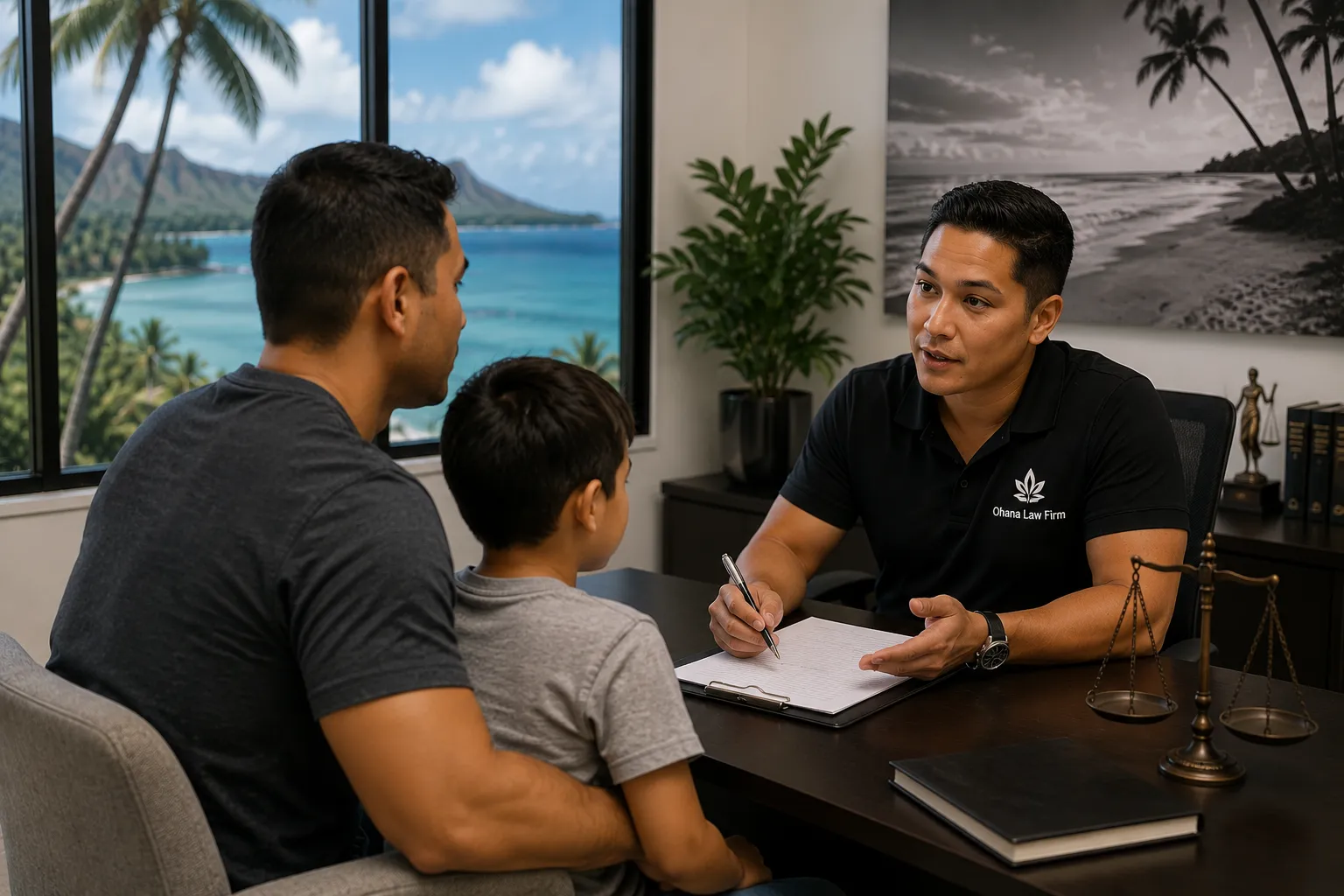
A father in the Puna district of Hawaii Island came to Ohana Law Firm believing he had no real shot at custody. The mother had already moved out with their two children and filed first.
Working with our child custody lawyer in Hawaii team, William Dean built a case around the father’s daily caregiving history, and the Hawaii Family Court Third Circuit ultimately awarded him primary physical custody.
That outcome surprises many Big Island fathers who assume courts favor mothers by default. Hawaii Revised Statutes Chapter 571, Section 571-46 does not say that. The law applies a gender-neutral best interests of the child standard to every parent who walks into the Hilo courthouse.
This guide explains what Hawaii family court actually weighs in a father’s custody case, what full custody really means, and when a Big Island father should call an attorney. This article is for educational purposes only and does not constitute legal advice. For advice specific to your situation, contact a licensed Hawaii attorney before taking any legal action.
| Yes, a father can get full custody in Hawaii. HRS Section 571-46 requires Hawaii Family Court to decide custody based on the best interests of the child, not the parent’s gender. Judges weigh caregiving history, stability, and each parent’s ability to meet the child’s needs. Fathers who show consistent involvement have won full custody across the Third Circuit, including Hilo and Kona. |
What Are a Father’s Custody Rights in Hawaii?
A father in Hawaii holds the same legal custody rights as a mother under Hawaii Revised Statutes Chapter 571. Section 571-46 requires Hawaii Family Court to award custody according to the best interests of the child, with no legal preference for either parent.
This gender-neutral standard applies whether the parents were married, divorcing, or never married. A father who was never married to the child’s mother must first establish paternity, but once paternity is confirmed, his custody rights under HRS 571-46 are identical to any mother’s.
Fathers on the Big Island sometimes hesitate to fight for custody because they assume the outcome is decided before the case starts. That assumption is incorrect and can cost a father the case if he does not present the same evidence a mother would.
This matters for fathers across Hawaii Island, whether they live in Hilo, Puna, Kona, or Hamakua. Hawaii County has one Third Circuit Court, but father’s rights cases are filed and heard at both the Hilo and Kona courthouse locations depending on where the family is domiciled.
How Hawaii Family Court Decides Custody: The Gender-Neutral Standard
Hawaii Family Court Third Circuit in Hilo weighs the same best interests factors for every parent, regardless of gender. HRS Section 571-46 directs the court to consider frequent, continuing, and meaningful contact with each parent unless that parent cannot act in the child’s best interest.
Judges also look at any history of abuse or neglect, each parent’s ability to provide a stable home, the child’s relationship with each parent, and the child’s own wishes when the child is old enough. None of these factors mention the parent’s gender.
Courts may order a custody evaluation in contested Big Island cases, especially between Hilo and Kona family court divisions. A father who has served as the primary caregiver, coached the child’s sports team, or handled school pickups builds the same kind of caregiving record that traditionally favored mothers.
Hawaii recognizes four custody arrangements under HRS Section 571-46.1: sole legal custody, sole physical custody, joint legal custody, and joint physical custody. A father can request any of these, and the court applies the same best interests analysis regardless of which arrangement he seeks.
Hawaii Family Court Rules also require most contested cases to include a written parenting plan under HRS Section 571-46.5. This plan spells out school-year time, holidays, and decision-making authority, giving fathers a concrete document to negotiate rather than an abstract legal argument.
Can a Father Get Full Custody in Hawaii?
A father can win full physical and legal custody in Hawaii when the evidence shows it serves the child’s best interests. Full custody is not automatically awarded to either parent. It is earned through documented caregiving, stability, and the child’s demonstrated needs.
Fathers most often succeed in full custody cases when they can show consistent daily involvement, a safe home environment on the Big Island, and evidence that the other parent’s situation is unstable or unsafe for the child.
Full legal and physical custody means a father has sole authority over major decisions, such as schooling and medical care, and the child primarily lives with him. Courts reserve this outcome for cases where shared arrangements would not serve the child, such as documented instability, abuse, or a parent’s unavailability.
A father pursuing full custody should also expect the court to look closely at his home environment. Hawaii Family Court considers whether a home on the Big Island offers a stable school district, safe housing, and consistent routines for the child.
Most Big Island custody cases settle into some form of joint custody rather than a full award to either parent. A father seeking full custody should be prepared to show why joint arrangements would not work for his specific children, not simply that he wants more time.
The table below breaks down typical costs and timelines for a Hawaii father’s custody case, from an uncontested agreement to a fully contested trial at the Third Circuit Court in Hilo.
| Case Type | Typical Cost | Typical Timeline |
| Uncontested parenting plan | $265 filing fee plus limited attorney review | 2-4 months |
| Contested custody with mediation | $2,500-$7,500 in attorney fees | 4-8 months |
| Contested custody with evaluator and trial | $10,000-$25,000+ in attorney fees | 8-18 months |
| Emergency temporary custody motion | $1,500-$4,000 in attorney fees | Days to a few weeks |
| Hawaii Family Court does not require a father to prove the mother is unfit to win primary or full custody. A father only needs to show that his proposed arrangement serves the child’s best interests better than the alternative. |
Steps a Hawaii Father Should Take to Protect Custody Rights
A Big Island father protects his custody rights by documenting his involvement from the very first sign of a dispute. Courts rely heavily on evidence, not assumptions, when awarding custody under HRS 571-46.
- Keep a written record of caregiving, including school pickups, medical appointments, and daily routines.
- File or respond to custody paperwork promptly at the Third Circuit Court in Hilo or Kona.
- Avoid disparaging the other parent in front of the children or in writing.
- Request a parenting plan that reflects real, workable time with your children.
- Consult a licensed Hawaii attorney before agreeing to any custody terms.
Fathers who wait until a hearing is already scheduled often lose valuable time to build their record. Early action, paired with legal advice from a Hilo family law attorney, gives a father the strongest position from the start.
When You Need a Hawaii Attorney for a Father’s Custody Case
A Hawaii father needs an attorney as soon as the other parent files for custody, limits access to the children, or threatens to relocate off the Big Island. Waiting to respond can weaken an otherwise strong case.
William Dean, Esq. has secured full custody outcomes for Big Island fathers by building evidence-based cases under HRS 571-46. His combined background in family law and finance also helps fathers navigate custody cases that involve child support, property, or a family business.
William Dean holds a Master of Science in Finance from Boston College along with his law degree, a combination that matters when a father’s custody case is tangled with a family business, rental property, or retirement accounts. Custody and financial issues often move together in a Big Island divorce, and separating them poorly can hurt both.
A father should also involve an attorney before agreeing to informal arrangements suggested by the other parent. Verbal agreements carry no weight in Hawaii Family Court, and a father who relies on one may find himself starting from a weaker position later.
Attorney involvement also matters at settlement conferences, where much of the custody outcome gets negotiated before any trial date. A father without counsel at this stage often accepts terms he would not agree to with legal guidance.
| Legal warning: No attorney can promise a specific custody outcome. The outcome of any legal matter depends on the specific facts and applicable law. Past results do not guarantee future outcomes. This article is for educational purposes only and does not constitute legal advice. For advice specific to your situation, contact a licensed Hawaii attorney before taking any legal action. |
Ohana Law Firm Serves Fathers Across the Big Island
Ohana Law Firm represents fathers throughout Hawaii Island, from Hilo and Puna to Kailua-Kona and the Kohala Coast. Every custody case is handled with direct attorney involvement, not a legal assistant or call center.
A father facing a custody dispute on the Big Island does not have to navigate Hawaii Family Court Third Circuit alone. Ohana Law Firm treats every Big Island client like family, from the first phone call through the final custody order.
Our office sits at 106 Kamehameha Ave, Suite B, in Hilo, close to Hale Kaulike, the Third Circuit courthouse on Kilauea Avenue. Fathers filing in Kona receive the same direct attorney access, and calls are answered 24 hours a day across Hawaii County.
Conclusion
Hawaii law does not favor mothers over fathers in custody cases. HRS Section 571-46 gives every parent an equal starting point, and fathers who build a strong record of caregiving and stability regularly win primary or full custody across the Third Circuit Court.
If you have questions about father’s custody rights on the Big Island, contact Ohana Law Firm for a free consultation. This article is for educational purposes only and does not constitute legal advice. For advice specific to your situation, contact a licensed Hawaii attorney before taking any legal action.
| Ohana Law Firm serves Big Island residents 24/7. Call 808-430-0704, your call goes straight to an attorney. Free consultation. Mahalo for reading. |
Frequently Asked Questions
What Hawaii law governs father’s custody rights?
Hawaii Revised Statutes Section 571-46 governs custody for fathers and mothers alike. The statute applies a gender-neutral best interests of the child standard, meaning judges cannot favor a mother over a father simply because of gender. Courts weigh factors like caregiving history, stability, and each parent’s ability to meet the child’s needs.
How much does a father’s custody case cost in Hawaii?
Filing a custody petition in Hawaii Family Court costs around 265 dollars in court fees alone, plus service of process fees. Contested cases with custody evaluators or trial can run several thousand dollars in attorney fees. Ohana Law Firm offers a free consultation so you can understand your likely costs before committing.
How long does a Hawaii custody case take?
An uncontested custody agreement in Hawaii can be finalized in a few months once both parents sign a parenting plan. Contested cases involving custody evaluators, mediation, or trial at the Third Circuit Court in Hilo often take six months to over a year. Timelines depend heavily on court calendars and case complexity.
Does Ohana Law Firm handle father’s custody cases on the Big Island?
Yes, Ohana Law Firm represents fathers throughout Hawaii Island, including Hilo, Kona, and Puna. William Dean has secured full custody outcomes for fathers facing contested cases at the Third Circuit Court. Call 808-430-0704 anytime for a free consultation about your specific custody situation on the Big Island.
When should a father contact a Hawaii attorney about custody?
A father should contact a licensed Hawaii attorney as soon as a custody dispute arises, especially if the other parent limits access or files first. Acting early protects your parental rights. This is educational information only, not legal advice. Consult a licensed Hawaii attorney about the specific facts of your case.
