
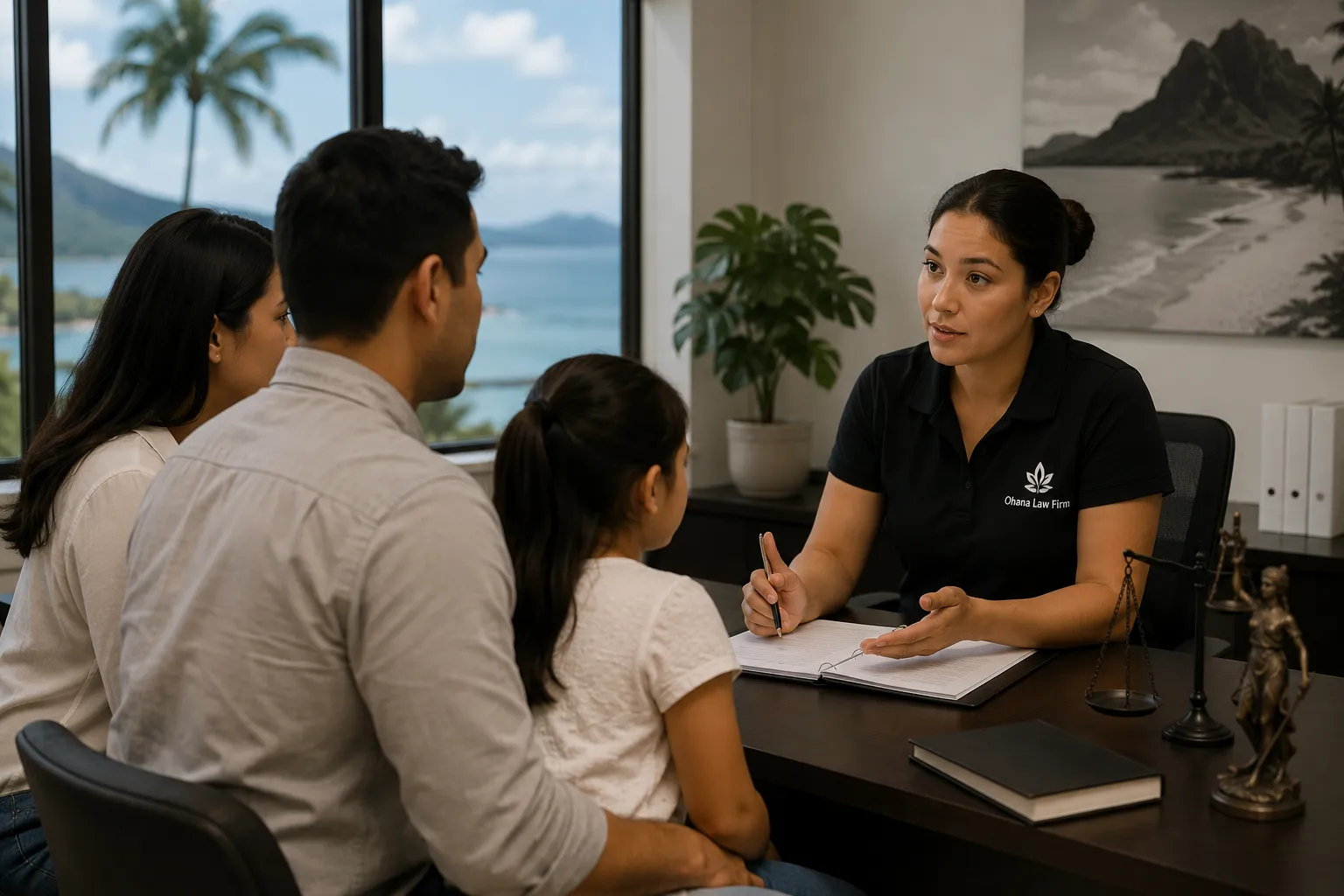
A family in the Puna district of Hawaii Island came to Ohana Law Firm after months of disagreement over where their children would live and go to school. Both parents loved their kids and neither had done anything wrong. What they needed was a clear picture of how a Hawaii Family Court judge actually makes that decision.
If you are searching for child custody Hawaii information, you are probably in a similar spot. This guide walks through how Hawaii Revised Statutes Chapter 571 governs custody, what Big Island judges weigh, and when to bring in a child custody lawyer in Hawaii.
The information in this article is for educational purposes only and does not constitute legal advice. For advice specific to your situation, contact a licensed Hawaii attorney before taking any legal action.
| Hawaii child custody decisions are governed by HRS Section 571-46, which requires Family Court judges to rule based solely on the best interests of the child. Judges weigh factors like caregiving history, the parent-child bond, any history of abuse, and a parent’s willingness to cooperate, with no automatic preference for mothers or fathers under Hawaii law. |
What Is Child Custody in Hawaii?
Child custody in Hawaii refers to the legal framework that decides where a child lives and who makes major decisions for them after parents separate. Hawaii law recognizes two distinct types of custody, and Hawaii Family Court judges can mix and match them to fit each family’s circumstances.
Legal custody covers major decisions such as schooling, healthcare, and religious upbringing. Physical custody covers where the child actually lives day to day, including the weekly and holiday schedule.
Under Hawaii Revised Statutes Chapter 571, specifically Section 571-46, a judge may award either type solely to one parent or jointly to both. For a broader look at how these rules interact with divorce filings, see our guide on how divorce works in Hawaii.
Custody can also arise outside of divorce. Unmarried parents in Hawaii establish custody and a parenting plan through a paternity action, and the same best interests standard applies whether the parents were ever married or not.
Hawaii courts do not favor mothers over fathers or fathers over mothers. Every custody decision, whether filed in Hilo or Kona, rests on one legal standard: the best interests of the child, and judges have broad discretion in how they apply it.
| Custody orders are not permanent. A parent can ask the Third Circuit Family Court to modify legal custody, physical custody, or the visitation schedule if circumstances have materially changed since the original order. |
How Hawaii Family Courts Decide the Best Interests of the Child
Hawaii Family Court judges apply a specific legal test, not personal preference, when they decide custody. HRS Section 571-46(b) lists 16 statutory factors judges must consider, and the statute makes clear the list is not exhaustive.
Those factors include each parent’s caregiving history before and after separation, the overall quality of the parent-child bond, any history of sexual or physical abuse or neglect, each parent’s cooperation on a parenting plan, and the child’s own wishes once the child is old enough for the court to weigh them.
Hawaii sets no fixed age at which a child’s preference controls the outcome. Judges typically weigh a child’s stated wishes alongside a custody evaluator’s recommendation rather than treating them as decisive on their own.
Family violence changes the analysis significantly. Under HRS Section 571-46(9), a judicial finding of family violence by a parent creates a rebuttable presumption against awarding that parent sole custody, joint legal custody, or joint physical custody.
When a court makes such a finding, the safety and well-being of the child and the parent who is the victim becomes the primary factor the judge must weigh above all others.
| If your case involves any history of family violence or abuse, do not attempt to navigate HRS 571-46(9) on your own. Consult a licensed Hawaii attorney before your first hearing. |
Legal Custody vs. Physical Custody: The Practical Difference
Many Big Island parents confuse legal and physical custody, so understanding the difference matters before a hearing or mediation session. The table below breaks down what each arrangement actually controls under Hawaii Family Court practice.
| Custody Type | What It Controls |
| Legal Custody | Who decides school, medical care, and religious upbringing for the child |
| Physical Custody | Where the child lives and sleeps on a day-to-day basis |
| Joint Legal Custody | Both parents share major decision-making authority equally |
| Sole Physical Custody | The child primarily resides with one parent, with visitation for the other |
| Joint Physical Custody | The child splits significant time living with both parents on a schedule |
Hawaii courts frequently award joint legal custody even when physical custody is not split evenly, on the theory that both parents should participate in major decisions. Judges are more cautious about ordering joint physical custody when parents live far apart, since frequent transitions can disrupt a child’s schooling and routine.
The Parenting Plan and Family Court Services Mediation Process
Every contested custody case in Hawaii starts with a written parenting plan under HRS Section 571-46.5. Both the Hilo and Kona divisions of the Third Circuit Family Court use a standard proposed parenting plan form covering legal custody, physical custody, holiday scheduling, and future dispute resolution.
When parents cannot agree, the Third Circuit’s Family Court Services office typically orders mediation with a child custody recommending counselor before the case proceeds to a contested hearing, unless the court has already found family violence.
The mediation session usually runs one and a half to two and a half hours in a private setting, and many Big Island custody cases resolve there rather than at trial.
Both parents must also complete the Kids First parent education program before Family Court will finalize a custody order, and children between the ages of six and eighteen attend a companion session. Mediation and evaluation costs vary, and Ohana Law Firm can walk you through what to expect during a free consultation.
Steps to Take If You Are Facing a Custody Dispute on the Big Island
Facing a custody dispute can feel overwhelming, but Big Island parents generally move through the same sequence of steps regardless of which district they live in.
1. Document your caregiving history, including school pickups, medical appointments, and daily routines, since HRS Section 571-46 specifically weighs this history.
2. Complete the required Kids First class as soon as your case opens, since Family Court will not finalize custody until both parents attend.
3. Prepare a realistic proposed parenting plan using the Third Circuit’s official form before your first hearing, addressing legal custody, physical custody, and holidays.
4. Attend Family Court Services mediation in good faith, since most Big Island custody cases resolve there rather than proceeding to a contested trial.
5. Consult a Hawaii attorney before you sign any agreement, since a parenting plan becomes a binding court order once approved and can be difficult to modify later.
When You Need a Hawaii Attorney for Child Custody
Some Big Island parents can resolve custody through mediation alone, especially when both sides largely agree on a schedule. Others face a dispute complicated by relocation, a parent’s substance use, allegations of abuse, or a business or property that makes the financial side complex.
William Dean, Esq. has represented Big Island parents in custody matters ranging from straightforward parenting plan disputes to contested trials involving family violence findings. In one Puna district case, William secured full custody for a client after presenting the other parent’s documented history of instability under HRS Section 571-46.
The outcome of any legal matter depends on the specific facts and applicable law, and past results do not guarantee future outcomes in any future case. Custody cases tangled up with property or a family business often benefit from the same financial background William brings to Ohana Law Firm’s family law team and to cases involving property division in a Hawaii divorce.
If your case involves a safety concern, an out-of-state relocation request, a parent who will not cooperate with mediation, or a custody evaluation you disagree with, consult a licensed Hawaii attorney before your next hearing rather than navigating the Third Circuit alone.
Ohana Law Firm Serves All Big Island Communities
Ohana Law Firm represents parents throughout Hawaii County, from Hilo and Puna to Kailua-Kona and Kohala. William Dean, Esq. appears regularly before the Third Circuit Family Court and understands how each division handles parenting plans, mediation referrals, and contested custody hearings.
His background, including a Master of Science in Finance from Boston College, is especially useful in custody cases tangled up with business ownership, investment property, or spousal support disputes.
Conclusion
Hawaii child custody cases turn on one question: what serves the best interests of the child under HRS Section 571-46. Understanding the factors a Third Circuit judge will weigh, and preparing a realistic parenting plan early, puts Big Island parents in a stronger position from the first hearing forward.
The information in this article is for educational purposes only and does not constitute legal advice, and the outcome of any custody matter depends on the specific facts of your case. If you have questions about child custody on the Big Island, contact Ohana Law Firm for a free consultation. Mahalo for reading, and we look forward to treating your family like our own ohana.
| Ohana Law Firm serves Big Island residents 24/7. Call 808-430-0704 — your call goes straight to an attorney. Free consultation. Mahalo nui loa. |
Frequently Asked Questions
What Hawaii law governs child custody?
Hawaii Revised Statutes Section 571-46 governs child custody, requiring Family Court judges to decide based on the best interests of the child. The statute lists specific factors judges must weigh, including each parent’s caregiving history, the parent-child relationship, and any history of abuse. There is no automatic preference for either parent.
How much does a child custody case cost in Hawaii?
Custody case costs in Hawaii vary widely depending on whether the case is contested. Attorney fees typically run $200 to $400 per hour, plus a $265 Family Court filing fee and possible mediation or custody evaluation costs. Ohana Law Firm offers a free consultation to review your specific situation and likely costs.
How long does a custody case take in Hawaii?
An uncontested custody case in Hawaii can resolve in a few months once paperwork and required Kids First classes are complete. Contested cases involving mediation, evaluations, or trial often take six months to over a year at the Third Circuit Family Court in Hilo, depending on the court’s calendar and case complexity.
Does Ohana Law Firm handle child custody on the Big Island?
Yes, Ohana Law Firm handles child custody cases throughout the Big Island, including Hilo, Kailua-Kona, Puna, and Kohala. William Dean, Esq. represents parents before the Third Circuit Family Court and its Kona division, guiding Big Island families through parenting plans, mediation, and contested custody hearings from start to finish.
When should I contact a Hawaii attorney about child custody?
Contact a licensed Hawaii attorney as soon as a custody dispute arises, especially if safety concerns, relocation, or a parent’s non-compliance is involved. The outcome of any custody matter depends on the specific facts and applicable law. Ohana Law Firm offers a free consultation to discuss your Big Island custody situation.
