
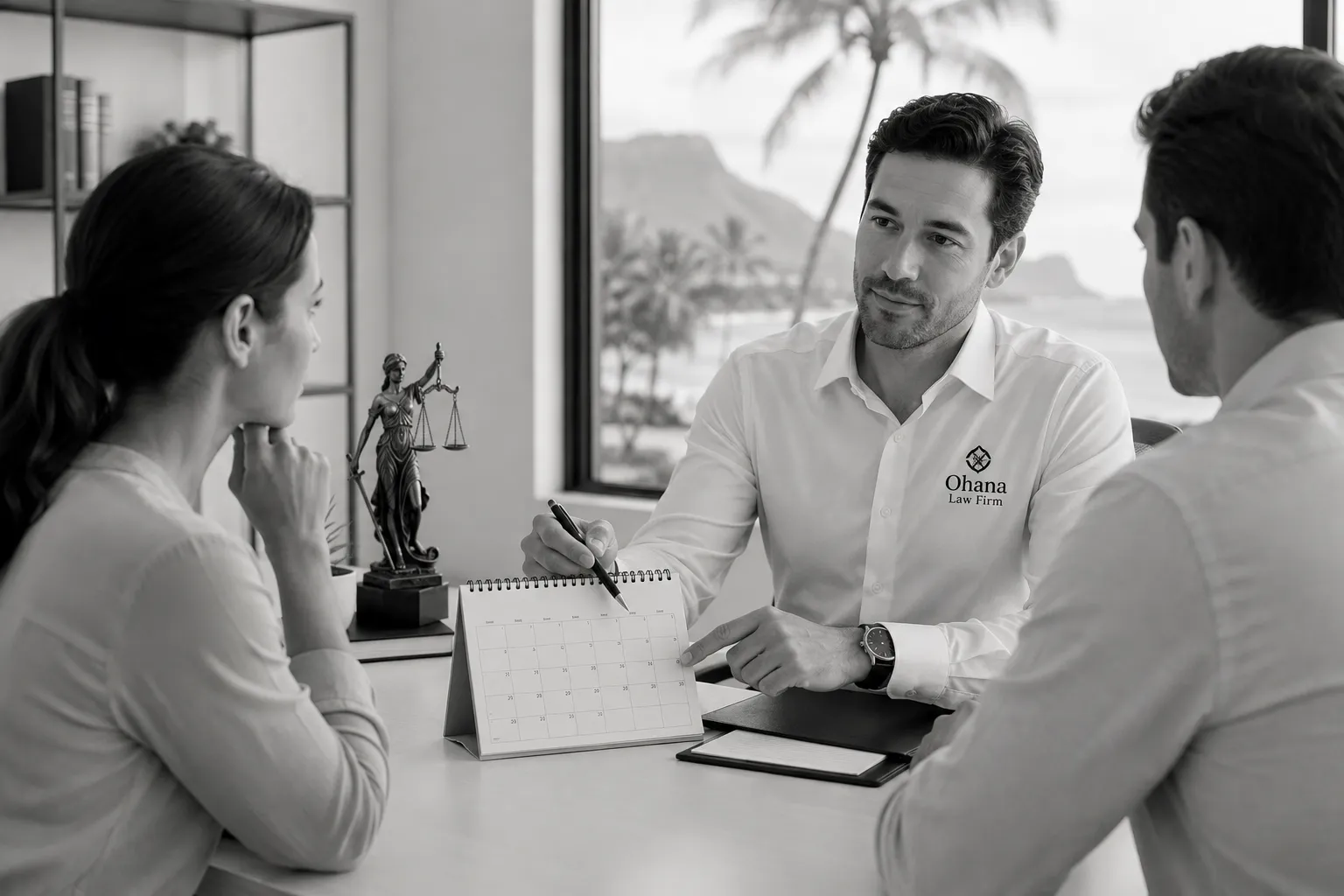
A client in Hilo came to Ohana Law Firm certain her divorce would take a year or more, because a friend on Oahu had waited that long. Her case involved no children, no contested property, and a spouse who agreed to the terms.
Working with our divorce lawyer in Hilo team, William Dean filed her uncontested paperwork with the Third Circuit Court, and her divorce was final in just over eight weeks.
That gap between expectation and reality is common. Hawaii Revised Statutes Chapter 580, Section 580-41 makes Hawaii a no-fault state with no mandatory waiting period, but most people never hear that part.
This guide breaks down exactly how long a Hawaii divorce takes, what separates a fast case from a slow one, and when a Big Island spouse should call an attorney. This article is for educational purposes only and does not constitute legal advice. For advice specific to your situation, contact a licensed Hawaii attorney before taking any legal action.
| An uncontested Hawaii divorce typically finalizes in six to ten weeks from filing. A contested divorce can take six months to over two years. HRS Section 580-41 imposes no mandatory waiting period, so the real driver of your timeline is whether you and your spouse agree on the terms. |
How Long Does a Hawaii Divorce Take? The Short Answer
A Hawaii divorce takes anywhere from six weeks to over two years, and the single biggest factor is whether the case is contested or uncontested. Hawaii Revised Statutes Chapter 580 governs every divorce filed in the state.
Most Hawaii spouses fall somewhere in between these extremes. A case with one or two minor disagreements, resolved through negotiation rather than trial, often finalizes in three to six months.
An uncontested divorce, where both spouses agree on property, support, and custody, typically finalizes in six to ten weeks once the paperwork is properly filed with the Family Court.
A contested divorce, where spouses disagree on one or more major issues, moves through discovery, temporary orders, and possibly trial. These cases commonly take six months to two years or longer at the Third Circuit Court.
This range holds true whether you are filing in Hilo, Kona, or anywhere else on Hawaii Island, since all Big Island cases go through the same Third Circuit Court system.
It also helps to understand that a case being contested does not always mean a courtroom battle. Many cases start out contested simply because paperwork was filed before spouses had time to negotiate, then settle into an agreement partway through.
Does Hawaii Have a Mandatory Divorce Waiting Period?
Hawaii does not have a mandatory waiting period for divorce. HRS Section 580-41 establishes Hawaii as a pure no-fault state, requiring only that the marriage is irretrievably broken, with no cooling-off period built into the statute.
This is a change many people miss, since older articles and some out-of-state sources still describe a waiting period that no longer applies. The Family Court can finalize an uncontested case as soon as the response deadline passes and paperwork is complete.
HRS Section 580-1, as amended in 2021, also removed the old six-month statewide residency requirement. A filing spouse now only needs to be domiciled in Hawaii, meaning they live here with the intent to remain, at the time of filing.
This does not mean a divorce happens overnight. The respondent spouse still has 20 days to answer if served in Hawaii, or 60 days if served outside the state, and the court needs time to process filings even in the simplest case.
Some Big Island residents also confuse the old rule with the current one because Hawaii did require six months of statewide residency before 2021. That residency rule applied to living in Hawaii generally, not to a case-specific waiting period, and it no longer applies to any divorce filed today.
Uncontested vs Contested Divorce: Timeline Comparison
An uncontested Hawaii divorce moves quickly because there is nothing for a judge to decide. Both spouses sign an agreement covering property, debt, support, and custody, and the court reviews and approves it.
A contested Hawaii divorce slows down at every stage where spouses disagree. Temporary orders under HRS Sections 580-9 and 580-11 may be needed early on to stabilize support and custody while the case is pending.
Mediation often bridges the gap between these two paths. A couple can start out contested, resolve most issues through a mediator, and finish with an agreement that looks much like an uncontested case by the time it reaches the judge.
The table below compares typical timelines and costs across the most common Hawaii divorce case types, based on current Family Court processing patterns. Use it as a starting point, not a guarantee, since every case has its own facts.
| Case Type | Typical Timeline | Typical Cost |
| Uncontested, no children | 6-8 weeks | $215 filing fee plus limited attorney review |
| Uncontested, with children | 6-10 weeks | $265 filing fee plus Kids First program fee |
| Contested, mediated settlement | 4-8 months | $5,000-$15,000 in attorney fees |
| Contested, full trial | 8-24+ months | $10,000-$50,000+ in attorney fees |
| Key insight: filing an uncontested divorce does not require you and your spouse to have no disagreements at all. It means you have resolved every disagreement in writing before the paperwork reaches the judge. |
What Can Speed Up or Slow Down Your Hawaii Divorce Timeline
A Hawaii divorce moves fastest when both spouses agree early and provide complete, accurate paperwork. Delays almost always trace back to disagreement, incomplete filings, or difficulty serving the other spouse.
- Reach agreement on property, support, and custody before filing whenever possible.
- Respond to all Family Court deadlines immediately, including the 20-day answer period.
- Gather financial documents and asset information early to avoid discovery delays.
- Use mediation for disputed issues instead of waiting for a trial date.
- Consult a licensed Hawaii attorney before signing any settlement terms.
Big Island cases can also face scheduling delays simply due to court calendar volume between the Hilo and Kona divisions. An attorney familiar with Third Circuit scheduling can help set realistic expectations from the start.
Another common delay comes from incomplete financial disclosures. A spouse who leaves out an asset or account, even accidentally, can trigger additional discovery requests that push a case back by weeks or months.
When You Need a Hawaii Attorney to Protect Your Timeline
A Hawaii spouse should involve an attorney as soon as a divorce is likely, especially if property, custody, or support disagreements exist. Early legal guidance prevents mistakes that extend a case by months.
William Dean, Esq. has guided Big Island clients through both fast uncontested filings and complex contested cases. His background in finance helps clients avoid the property and support disputes that most often turn a quick case into a long one.
This financial background matters most in cases involving a family business, rental property, or retirement accounts, where an incomplete valuation can stall a case for months while experts weigh in.
Clients who try to negotiate financial terms without legal guidance sometimes agree to terms that create new disputes later, restarting parts of the timeline. A short consultation early on often saves months down the line.
A spouse should also contact an attorney immediately if the other spouse cannot be located for service, since this alone can add weeks or months to any Hawaii divorce timeline.
An attorney can also request temporary orders under HRS Sections 580-9 and 580-11 early in a contested case, so support and custody arrangements are stable while the rest of the timeline plays out.
| Legal warning: No attorney can guarantee an exact divorce timeline. The outcome of any legal matter depends on the specific facts and applicable law. Past results do not guarantee future outcomes. This article is for educational purposes only and does not constitute legal advice. For advice specific to your situation, contact a licensed Hawaii attorney before taking any legal action. |
Ohana Law Firm Guides Big Island Divorce Timelines
Ohana Law Firm represents divorcing spouses throughout Hawaii Island, from Hilo and Puna to Kailua-Kona and the Kohala Coast. Every client receives a realistic timeline estimate at the very first consultation.
A Big Island spouse does not have to guess how long their case will take. Ohana Law Firm treats every Big Island client like family, walking through the likely timeline before any paperwork is filed.
Clients often ask whether filing in Hilo versus Kona changes the timeline. Both divisions of the Third Circuit Court follow the same statutes and rules, though calendar availability can shift the schedule by a few weeks in either direction.
Our office sits at 106 Kamehameha Ave, Suite B, in Hilo, close to Hale Kaulike, the Third Circuit courthouse on Kilauea Avenue. Clients filing in Kona receive the same direct attorney access, with calls answered 24 hours a day across Hawaii County.
Conclusion
Most Hawaii divorces take far less time than people expect, especially when both spouses agree on the terms. HRS Section 580-41 removes the mandatory waiting period that once slowed every case down, and an uncontested filing can be final in as little as six weeks.
Understanding your realistic timeline early, rather than assuming the worst case, lets you plan finances, housing, and parenting arrangements with far less stress during an already difficult time.
If you have questions about your divorce timeline on the Big Island, contact Ohana Law Firm for a free consultation. This article is for educational purposes only and does not constitute legal advice. For advice specific to your situation, contact a licensed Hawaii attorney before taking any legal action.
| Ohana Law Firm serves Big Island residents 24/7. Call 808-430-0704, your call goes straight to an attorney. Free consultation. Mahalo for reading. |
Frequently Asked Questions
What Hawaii law governs how long a divorce takes?
Hawaii Revised Statutes Chapter 580 governs divorce, with HRS Section 580-1 setting domicile requirements and HRS Section 580-41 establishing no-fault grounds. Hawaii imposes no mandatory statutory waiting period between filing and a final decree, though the Family Court still requires proper service, response deadlines, and paperwork review before finalizing any case.
How much does a Hawaii divorce cost?
An uncontested Hawaii divorce costs around 215 to 265 dollars in Family Court filing fees, plus service of process. Contested divorces with attorney representation often run 10,000 to 50,000 dollars or more depending on complexity. Ohana Law Firm offers a free consultation to discuss the likely cost range for your specific situation.
How long does an uncontested divorce take in Hawaii?
An uncontested Hawaii divorce typically finalizes in six to ten weeks from filing once both spouses agree on all terms. The Family Court still needs time to process paperwork, confirm the response deadline has passed, and schedule the final decree, even without a mandatory waiting period.
Does Ohana Law Firm handle divorce timelines on the Big Island?
Yes, Ohana Law Firm represents clients filing for divorce throughout Hawaii Island, including Hilo, Kona, and Puna. William Dean helps clients set realistic timeline expectations from the first consultation. Call 808-430-0704 anytime for a free consultation about your specific Big Island divorce timeline.
When should I contact a Hawaii attorney about my divorce timeline?
Contact a licensed Hawaii attorney before filing if you want to understand how contested issues could extend your timeline. Acting early helps you plan realistically. This is educational information only, not legal advice. Consult a licensed Hawaii attorney about the specific facts of your case.
