
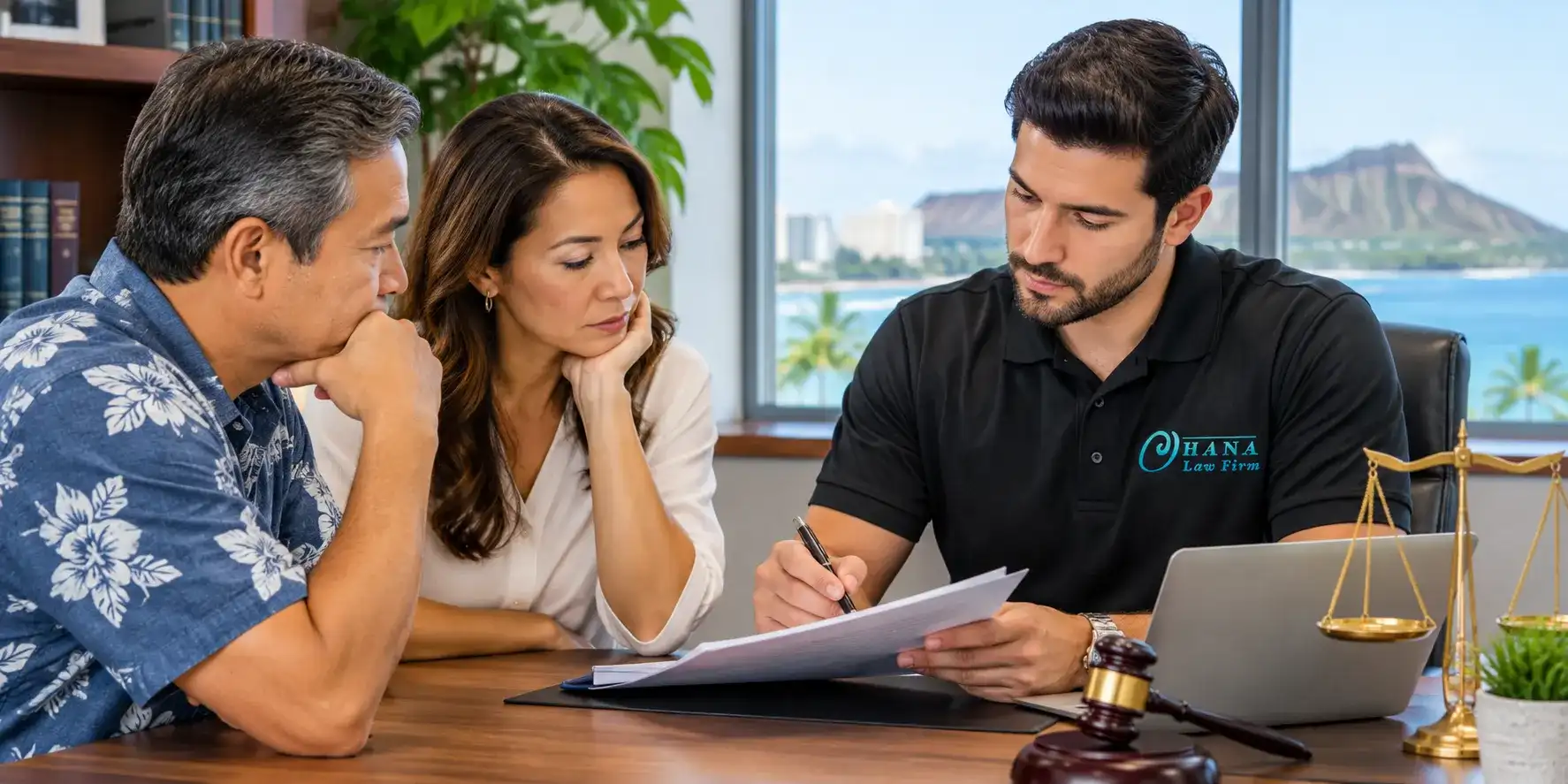
Your 401(k) may be the largest asset you own after your home, and divorce puts it on the table. Ohana Law Firm helps Big Island residents protect retirement savings during divorce. William Dean, who also holds an MS Finance from Boston College, sat with a Kona couple to map how each account would be treated before either spouse signed.
Hawaii is an equitable distribution state, not a community property state. That means the Family Court divides the marital estate justly and equitably, and retirement earned during marriage is often part of that division.
The information in this article is for educational purposes only and does not constitute legal advice. For advice specific to your situation, contact a licensed Hawaii attorney. The outcome of any legal matter depends on the specific facts and applicable law. Past results do not guarantee future outcomes.
In Hawaii, retirement earned during marriage is generally marital property and may be divided by the Family Court under Hawaii Revised Statutes Section 580-47. A 401(k) or pension usually needs a Qualified Domestic Relations Order, while an IRA moves by trustee-to-trustee transfer. Social Security is not divided by the court.
1. Is Retirement Marital Property in a Hawaii Divorce?
Yes, retirement earned during marriage is generally marital property in Hawaii. Money earned before marriage, or after separation, may be treated in a different way, based on the facts and records for each account.
Division follows Hawaii Revised Statutes Section 580-47, under which the Family Court divides the marital estate justly and equitably. The court uses the partnership model, with marital property generally starting at a 50/50 split before valid equitable deviations.
That starting point is not a fixed rule for every case. The court may adjust the split for valid reasons, such as the length of the marriage, each spouse’s contributions, and other property each spouse receives.
Keep statements that show the balance on the date of marriage and the date of separation. Those two numbers often decide how much of an account counts as marital property.
Ask your plan for a statement that breaks out employee and employer contributions. Employer matches earned during marriage are often marital too, even when they vest at a later date.
2. What Happens to Your 401(k) in a Hawaii Divorce?
Your 401(k) balance earned during marriage is generally part of the marital estate, even if only one spouse worked outside the home. The court looks at the marital share, not just the name on the account.
A 401(k) generally needs a Qualified Domestic Relations Order, known as a QDRO, under federal ERISA rules. See the Hawaii Revised Statutes for the text of Hawaii law. A divorce decree alone is usually not enough for the plan administrator to pay or transfer the awarded share.
The QDRO tells the plan how much to pay, to whom, and when. It must match the decree and the plan rules, so have it drafted with care and filed with the plan administrator.
Decide whether the awarded share will stay in the plan, roll to an IRA, or pay out in cash. Each choice has tax and timing effects, so make the choice with advice, not haste.
3. How Are Pensions Divided in Hawaii?
Pensions are also divided under Hawaii Revised Statutes Section 580-47, using the same just and equitable standard as other marital property. The marital share is based on the part earned during the marriage.
Defined benefit pensions are often divided by the Linson formula: one-half times years credited during marriage divided by total years credited at retirement, times the gross benefit. This formula gives the non-employee spouse a share tied to the marriage years.
Get a current pension statement and a clear record of service dates before you agree to a split. For help with this part of your case, talk with a divorce lawyer in Hilo about your pension records.
Ask whether the pension pays a lump sum, a monthly benefit, or both. The payment form affects value, tax, and the QDRO terms, so do not agree to a split before you know it.
| Account type | How it is divided | QDRO needed? |
| 401(k) | QDRO under ERISA rules | Yes |
| Defined benefit pension | QDRO, often by Linson formula | Yes |
| IRA | Trustee-to-trustee transfer | No |
| Social Security | Not divided by the court | No |
4. IRAs, Social Security, and Other Retirement Benefits
IRAs do not need a QDRO. They move by trustee-to-trustee transfer incident to divorce, which sends the awarded share straight from one IRA custodian to the other.
Social Security is not divided by the court. A 10-year marriage may support a divorced-spouse benefit claim with the Social Security Administration, based on your own record and the rules in effect at that time.
Other benefits, such as deferred compensation, stock options, and military retirement, may also be marital property. Gather statements for every plan, and ask your attorney which ones the court may divide.
Do not forget a second job, a union pension, or an old employer plan from before you moved to Hawaii. Old accounts are easy to miss, and they can still hold marital value.
Check for survivor benefits on a pension, too. A survivor benefit can matter for a former spouse after the employee spouse dies, and it must be named in the QDRO and the decree.
5. Taxes and Costly Mistakes to Avoid
Do not withdraw cash from a 401(k) and hand it to your spouse. A cash withdrawal can trigger income tax and a 10 percent early withdrawal penalty if you are under 59 and a half.
A QDRO transfer and a trustee-to-trustee IRA transfer, done the right way, can avoid those tax and penalty risks. The method matters as much as the amount, so follow the plan rules step by step.
Do not trade a retirement share for a home or other asset without a full comparison of value, tax, and risk. A dollar in a 401(k) is not the same as a dollar of home equity, because tax and access rules differ.
Check for loans against a 401(k) before you agree to a split. A loan lowers the value you can divide, and the plan may treat repayment in a way that changes what each spouse receives.
Do not sign a QDRO you have not read in full. Check the names, dates, amounts, and payment terms against the decree, and ask the plan to confirm it will accept the order as written.
6. What to Gather Before You Divide Retirement Accounts
Start with a list of every retirement account, with the most recent statement for each one. Note the plan type, the balance, the dates of service, and any loans or prior withdrawals.
Ask each plan administrator for its QDRO rules and forms. Plans differ, and a QDRO that works for one plan may not work for another, so confirm the rules before you draft it.
For a full review of your property, read our guide to property division in Hawaii and our Hawaii family law services. Bring your statements to your free consultation, so the review starts from real numbers.
Make a short list of questions before that first call, such as which accounts are marital, what a QDRO will cost, and when the transfer can happen. Clear questions lead to clear answers.
Conclusion
Divorce retirement accounts Hawaii cases turn on one question: what part of each account was earned during the marriage? From that answer, the court can divide the marital share justly and equitably under Hawaii Revised Statutes Section 580-47.
If you live in Hilo, Kona, Puna, Kohala, or elsewhere in Hawaii County, get advice before you sign an agreement that trades away retirement.
The information in this article is for educational purposes only and does not constitute legal advice. For advice specific to your situation, contact a licensed Hawaii attorney. The outcome of any legal matter depends on the specific facts and applicable law. Past results do not guarantee future outcomes.
Talk With Ohana Law Firm
Ohana Law Firm serves Big Island residents 24/7. Call 808-289-5199, and your call goes straight to an attorney. Your consultation is free. Our office is at 106 Kamehameha Ave, Suite B, Hilo, HI 96720.
Frequently Asked Questions
What Hawaii law governs divorce retirement accounts in Hawaii?
Hawaii Revised Statutes Section 580-47 governs property division in Hawaii divorce cases, including retirement accounts earned during marriage. The Family Court divides the marital estate justly and equitably, using the partnership model. A 401(k) or pension also needs a Qualified Domestic Relations Order under federal ERISA rules.
How much does it cost to divide retirement accounts in a Hawaii divorce?
Costs vary with the facts of each case, including the number of accounts, the need for a QDRO, and whether the division is contested. QDRO drafting and plan review add cost, while an agreed split costs less. Contact Ohana Law Firm for a free consultation and a clear fee estimate.
How long does it take to divide retirement accounts in Hawaii?
Division often takes weeks to months after the decree, based on QDRO drafting, plan review, and the time each plan administrator needs to act. Uncontested cases typically move faster than contested cases. Your attorney can give a timeline once your account records and plan rules are reviewed.
Does Ohana Law Firm handle retirement division cases on the Big Island?
Yes. Ohana Law Firm serves clients across Hawaii Island, including Hilo, Puna, Kona, Kohala, Ka’u, Waimea, and Hamakua, in the Hawaii Family Court, Third Circuit. The firm serves Big Island residents 24/7, and your call goes straight to an attorney. Call 808-289-5199 for a free consultation.
When should I contact a Hawaii attorney about retirement accounts in divorce?
Contact an attorney before you sign any agreement that divides a 401(k), pension, or IRA. Early advice can prevent tax costs, penalty risks, and a QDRO that the plan will not accept. Call Ohana Law Firm at 808-289-5199 for a free consultation and advice specific to your situation.
